
· by Michael Blair, Nashville's Handyman Service
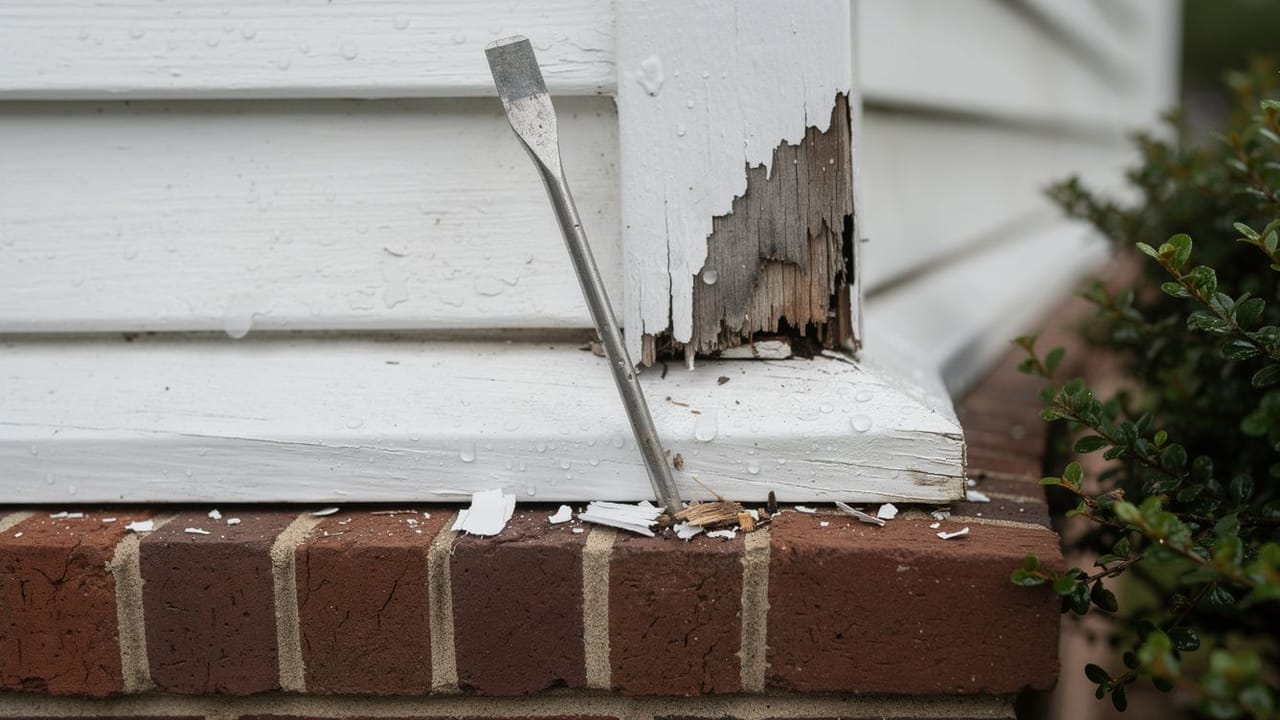
On a lot of the older Nashville houses we work on, a screwdriver pressed into the bottom corner of a window sill, the base of a door jamb or the lower end of a corner board goes in further than it should. Trim takes the weather before anything else does, and Nashville’s normal precipitation is 50.51 inches a year on the 1991 to 2020 averages kept by the National Weather Service’s Nashville office. The USDA Forest Products Laboratory’s Wood Handbook chapter on finishing wood points to any end grain, especially on bottom surfaces where water sits, as the problem area, and that is where we find it too. Whether a soft spot gets repaired or the piece gets replaced comes down to how far the rot has traveled.
Finding how much is soft
Rot can be well along inside a board before the paint gives it away. The Wood Handbook’s finishing chapter says decay often sits in the center of a board while the surface looks sound, and its advice is to probe several spots with a small-tipped screwdriver. We run an awl along the whole piece, not only the spot that caught your eye. The National Park Service’s Preservation Brief 9 on repairing wood windows describes the tell: pry up a little of the surface and sound wood comes away in long fibrous splinters, while decayed wood lifts in short, irregular pieces. Mark where the soft wood stops.
Then look at the neighbors. The same brief says deterioration usually begins on horizontal surfaces and at joints where water can collect, so soft wood at the base of a casing is our cue to probe the sill under it, and a soft foot on a door jamb sends us checking whatever it sits on. If a piece of the trim will pull back, we look at the sheathing behind it as well. It can be soft too where water has been getting in for a while, and soft sheathing turns trim work into opening the wall.
When can rotted trim be repaired instead of replaced?
If the rot is confined to a small spot at a corner or an end and the rest of the piece is sound, an epoxy repair is worth doing. Preservation Brief 9 lays out the method: a semi-rigid epoxy soaks into the porous decayed wood and hardens, then an epoxy patching compound is built up over it, sanded and painted, and the brief calls the finished patch durable and waterproof. We dig out the soft wood first, let what remains dry, and slope the top of a sill patch slightly so water runs off rather than sitting on it, which the brief also asks for. Ordinary wood putty is a different thing; the brief keeps putties and filler mixtures for wood that is weathered at the surface, and the epoxy is what goes into decayed wood.
A sill that is soft along its whole front edge, a jamb gone for its bottom foot, or a corner board soft a third of the way up is past that point. Our rule of thumb is that once a patch would be doing the wood’s job, the piece comes out, and the Wood Handbook’s instruction for decayed boards is just as short: replace them.
- Small, contained soft spot on a sound piece: epoxy consolidant and epoxy patching compound
- Rot along an edge or up a length: cut out and replace the section or the piece
- Rot into the sheathing or framing: open the wall and fix the leak
- Any repair: prime every cut end before it goes back
Replacing the piece
A sill can be cut out and a new one let in under the casing, a jamb leg can be cut above the rot and a new section spliced on, and a corner board is usually simplest to replace whole. On a house built before 1978, check for lead before any painted trim comes off. EPA’s Renovation, Repair and Painting Program requires anyone paid to disturb painted surfaces in those homes to be certified in lead-safe work practices, and the small-job allowance in EPA’s answer on 20 square feet of exterior paint does not stretch to window replacement or demolition of painted surfaces.
The new piece should be something that won’t go the same way. AZEK’s technical data sheet for its Classic Trim describes the boards as rot-resistant cellular PVC, which is the maker’s own claim. Composites with wood fiber in them are another matter: a Forest Products Laboratory study of wood-plastic composite boards looked at boards that had decayed outdoors in Hawaii. If it is wood, the Wood Handbook’s chapter on biodeterioration says heartwood of a decay-resistant species generally gives satisfactory service above ground, and we prime it on all six sides, cuts included. The finishing chapter has a photo that makes the case: cedar porch railing parts after 25 years, where every piece with primed end grain was in perfect condition and every one left unprimed on the bottom had rotted.
Before the new piece goes on, we find out why the old one rotted and deal with that. At a window or door we check for a drip cap over the head, a sill pan under the unit, house wrap lapped the right way, and any horizontal joint that holds water. The Wood Handbook’s rule is to overlap from above so water is carried away from the structure, and Preservation Brief 9 says any condition that lets water reach the wood or puddle on the sill must be corrected. Skip that step and the new trim goes back into the same water.
Why does exterior trim rot?
Water gets into trim at unsealed end grain, at joints where two pieces meet, at the gap where caulk has pulled away from siding, and from below where the trim touches a deck, a step or the ground. End grain matters most: the finishing chapter says liquid water enters it 10 to 100 times faster than the other faces. Humid air on its own is not what rots trim. The biodeterioration chapter says water vapor alone will not wet wood enough for significant decay; that takes rain, condensation or wet ground. Warmth sets the pace, since decay runs slowly below 50 °F and above 95 °F, and the Weather Service’s normal mean for a Nashville July is 80.7 °F.
Sun-facing walls are harder on paint. The finishing chapter notes that splits and checks in the wood lead to cracks in the paint film and that water reaches the wood quickly under a crack, and where two topcoats everywhere are not practical it suggests putting them on the fully exposed south and west sides.
Once it’s repaired, seal and paint the ends; Forest Products Laboratory work on painted siding found that sealing end grain with primer decreases paint peeling near the ends of boards. Keep paint on the bottom edges, and leave a gap under any board exposed to weather so its bottom edge dries after rain, as the handbook advises. Caulk the joints meant to be sealed, such as the one between a sill and the jamb, and look at them every year, but never caulk a drainage gap or the overlap of lap siding; the handbook warns that a failed sealant often traps water and leaves things worse than no sealant at all. Our post on choosing the right caulk covers which product goes where.
The handbook also says to inspect for decay whenever you repaint. We would add a walk around the house with a screwdriver to the seasonal maintenance list, because a soft spot found while it is small is a short epoxy job and one left to spread is a carpentry job. Replacing rotted sills, casing and corner boards is part of our carpentry work, and if you want us to look at yours, ask for a free estimate.
Sources
- USDA Forest Products Laboratory, Wood Handbook (FPL-GTR-282) Chapter 16: Finishing Wood (Hunt, 2021) — End grain and bottom surfaces as the problem areas; decay in the center of a sound-looking board, probe with a small-tipped screwdriver; replace decayed boards; cedar porch styles with and without primed end grain after 25 years; overlap from above; water enters end grain 10 to 100 times faster; paint cracks from checks in the wood; two topcoats on exposed south and west sides; keep end grain painted; gap below boards; failed sealants trap water; inspect for decay when repainting
- National Park Service, Preservation Brief 9: The Repair of Historic Wooden Windows (Myers, 1981) — Awl or ice pick test, long splinters versus short pieces; deterioration starts on horizontal surfaces and joints; epoxy consolidation and patching, durable and waterproof; slope the patch; putties for surface weathering; splicing and parts replacement; conditions that let water puddle must be corrected; caulk the sill-to-jamb joint
- USDA Forest Products Laboratory, Wood Handbook (FPL-GTR-190) Chapter 14: Biodeterioration of Wood (Clausen, 2010) — Resistant heartwood gives satisfactory service above ground; humid air alone does not support significant decay; decay slow below 50 °F and above 95 °F
- National Weather Service Nashville, Nashville climate normals 1991-2020 — Normal annual precipitation 50.51 inches; normal July mean temperature 80.7 °F
- US EPA, Lead Renovation, Repair and Painting Program — Anyone paid to disturb painted surfaces in pre-1978 homes must be certified in lead-safe work practices
- US EPA, Frequent question: projects disturbing 6 square feet interior or 20 square feet exterior — Minor-repair allowance excludes prohibited practices, window replacement and demolition of painted surfaces
- AZEK, Classic Trim technical data sheet (2025) — Manufacturer describes its trim as rot-resistant cellular PVC; painting guidance: 100% acrylic latex, darker colors from approved charts, wrong paint can cause overheating and warping
- USDA Forest Products Laboratory, Exterior Decay of Wood-Plastic Composite Boards (Ibach et al., 2016) — Wood-plastic composite boards decayed in outdoor exposure near Hilo, Hawaii
- USDA Forest Products Laboratory, Improving the performance of painted wood siding (Burke et al., 2009) — Sealing end grain with primer decreases paint peeling near board ends
FAQ
Rotted Window Trim and Sills: Repair or Replace — questions
Can rotted wood be repaired with filler?
Small, contained rot on an otherwise sound piece can be repaired with an epoxy consolidant and an epoxy patching compound, which holds up when the soft wood is dug out and the rest has dried before it goes on. Ordinary wood putty is meant for wood that is weathered at the surface, not for rebuilding decayed wood. Rot along an edge or up a length of trim is cut out and replaced.
What should replacement exterior trim be made of?
Cellular PVC trim is sold as rot-resistant, and its maker says to paint it with 100% acrylic latex exterior paint and to pick darker colors from its approved list, because the wrong paint can make the boards overheat and warp. Composites with wood fiber in them can still decay. If wood is used, it should be heartwood of a decay-resistant species, primed on all sides and on every cut end before installation.
Why does my window trim keep rotting on one side of the house?
The side with the most sun tends to be hardest on paint, and once the paint cracks, water reaches the wood quickly. That is why the Forest Products Laboratory suggests an extra topcoat on fully exposed south and west walls. A missing drip cap, open joints or bare end grain on that side lets more water in. Fix the water path, seal the ends and keep paint on the wood.
How do you replace a rotted window sill?
Cut the old sill out and let a new one in under the casing, made of cellular PVC or decay-resistant heartwood primed on all six sides. In a house built before 1978, check the paint for lead first. Before the new sill goes in, find why the old one rotted, such as a missing drip cap or sill pan.