
· by Michael Blair, Nashville's Handyman Service
When we cut out a failed bead of caulk, the cause is usually one of three things: the wrong product for the joint, a joint that moves more than that product can stretch, or a joint that was not clean and dry when the bead went in. The second and third are bigger than they sound. The NIH’s facilities engineers, in a bulletin on sealant joint design, say that good materials and perfect technique cannot make up for a badly designed joint, and GE’s data sheet for its tub and tile silicone says the surface must be clean, dry and sound. The first is the easiest to get right, because the tube says what it is made for, and it is where we start. Recaulking a tub or a window is part of our general repairs work.
The four families
Acrylic latex caulk is the painter’s caulk. It cleans up with soap and water and takes paint, and how far it stretches depends on the grade. A basic acrylic is the stiffest of the four, but the better ones are rated higher than most people expect: GE’s MAX Shield painter’s sealant is rated for 25% joint movement in both expansion and recovery, the same figure GE gives its 100% silicone tub sealant. It belongs on interior trim, crown, baseboards and casing, where it gets painted over. That same sheet rules it out for anything below grade or in water, so it has no place in a tub or shower joint. Outside, it comes down to the grade printed on the tube. GE’s All Weather Pro, a siliconized acrylic, is sold for exterior siding, trim, doors and windows, so we use an acrylic outside only when the label says exterior and gives a movement rating.
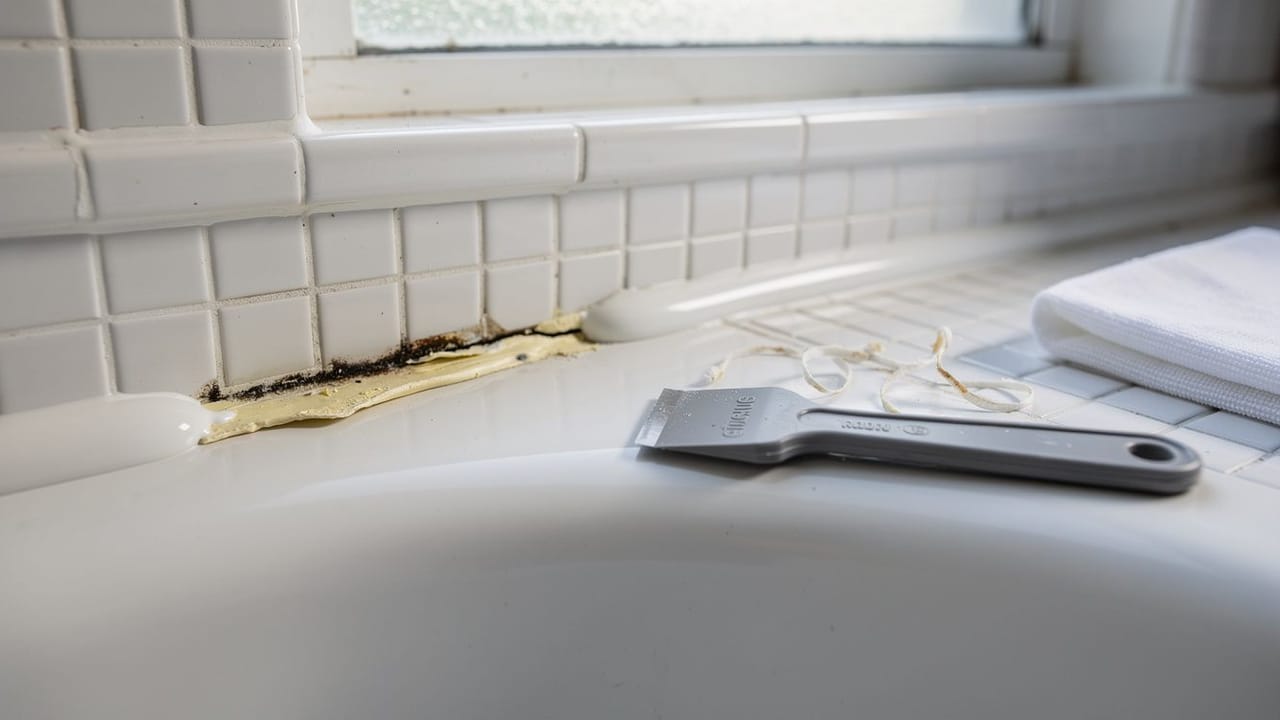
Silicone stays flexible and sheds water. The tub and tile sheet promises permanent flexibility and a cured bead that resists mold and mildew, while still saying it needs regular cleaning and is not for a joint in constant contact with water. It cannot be painted; GE lists it as non-paintable. Old sealant is on GE’s list of contaminants that must come off before a new bead will bond, and its instructions are to cut, peel and scrape out as much of the old bead as possible, then clean what is left. Silicone is our pick around tubs, showers, sinks, backsplashes and glass.
Polyurethane is made to move outdoors. Sika’s data sheet for Sikaflex-1A rates it for 35% movement, lists window and door frames and facade elements among its uses, and says it can be painted over with oil- and rubber-based paints. Hybrid products, sold as silicone-modified or polymer sealants, sit between silicone and polyurethane. Sika’s MS-polymer hybrid claims very good UV resistance, takes water-based paint and names window and door frames, roofing and gutters among its uses. GE’s Paintable Silicone Supreme, a silane-modified polymer rated for 50% movement, is the indoor version, sold for kitchens, baths and interior work.
- Interior trim to be painted: acrylic latex
- Tub, shower, sink, backsplash, glass: silicone, or a paintable hybrid labeled for baths where the joint must be painted
- Exterior trim, windows, doors and siding: polyurethane, a hybrid, or an acrylic rated for exterior use
- Anything painted outside: never pure silicone; pick a product whose sheet names the paint you are using
Why does the caulk around a tub keep splitting?
The joint where a tub meets the tile moves, and a caulk not made to move with it splits. A full tub is heavy, the tub and the wall are different materials, and the bead between them has to stay stuck to both. A painter’s acrylic, or any caulk not made for a wet joint, tends to crack along one edge, water gets in behind it, and the mildew follows. GE sells its tub and tile silicone for sinks, tubs, showers and backsplashes and rates it for 25% movement under the ASTM C719 test, which is the kind of product that joint calls for.
The fix is a proper silicone bead on a joint that is clean, dry and free of the old caulk, and then some patience. You may have heard that filling the tub before caulking holds the joint open while the silicone cures. GE’s tub and tile sheet does not call for it, so we leave it out and follow the cure time instead: the sheet says to keep water off the new bead for 24 hours, or 12 hours if the bead is no wider than a quarter inch and the room is at least 65°F and 50% humidity.
Outside, and what Middle Tennessee does to it
Exterior joints take sun and rain and open and close as the house heats and cools through the year. A builder-grade acrylic tends to give out sooner out there than a product rated for it, so before anything goes on a wall we read two things on the tube: whether it says exterior, and its movement rating. The weather on the day matters as much. The All Weather Pro sheet says to wait if rain is expected within 24 hours, not to caulk wet, damp or frozen surfaces, and not to apply it when the relative humidity is above 90%. Sika says its hybrid cures without bubbles even in wet and humid conditions and does not shrink. Where a failed joint has already let water into the wood, our post on rotted window trim and sills covers what we do before any new caulk goes on.
The joint also has to be sized for the caulk to work. GE’s tub and tile sheet keeps beads between 1/8 and 1/2 inch thick at a width-to-depth ratio of 2 to 1, and calls for backer rod in gaps larger than 3/8 inch deep and wide. A deep bead is slow to cure, too: GE gives its paintable hybrid a cure rate of 2 to 3 millimeters a day. The backer rod is there so the caulk grips the two sides and not the back, and the NIH bulletin calls for a closed-cell backer rod or bond breaker for exactly that reason. Caulk stuck on three sides cannot stretch freely, and it tears. The federal guide specification for joint sealants, UFGS 07 92 00, takes the same line, calling for bond breakers on surfaces the sealant should not stick to and backstops where a joint is too deep.
How should a joint be prepared before caulking?
No caulk bonds to dust, mildew, soap film or old caulk. GE’s tub sheet lists old sealants, dirt, oils and soap residue among what has to come off, and it warns against cleaning with soap and water because silicone will not stick where soap scum remains. The UFGS says the same about resealing: take out the existing caulk before the new sealant goes in. Cut and scrape the old bead out, then clean with what the product calls for. For cured residue, GE says mineral spirits on tile and fiberglass and rubbing alcohol on hard plastics and painted surfaces, never mineral spirits there, and rubbing alcohol wherever mildew is present. Let the joint dry; GE suggests cleaning an hour or two ahead so it has time. Tool the bead within its open time, five to ten minutes for GE’s tub silicone, pressing it into both sides, and then leave it alone.
Skipping any of that is how a fresh bead ends up peeling away from one side within months. Done properly, each type holds up to the job it was made for, and the makers put their names behind it: GE gives its tub and tile silicone a lifetime guarantee and seven years of mold-free protection. Acrylic on interior trim only has to last until the next repaint, which is all it was ever meant to do. If you have a tub, a shower or a run of exterior trim that needs new caulk, send us a note and we will come and look at it.
Sources
- GE Sealants, Tub and Tile Silicone 1 Kitchen and Bath Sealant, technical data sheet (rev. March 20, 2026) — Surfaces clean, dry and sound; old sealant and soap residue stop adhesion; mineral spirits or rubbing alcohol by surface; non-paintable; ±25% movement (ASTM C719); not for continuous water contact; 24-hour (or 12-hour) water exposure; 5–10 minute open time; backer rod over 3/8 inch; beads 1/8 to 1/2 inch at 2:1; lifetime guarantee and 7-year mold-free protection
- GE Sealants, MAX Shield Painter’s Advanced Polymer Acrylic Latex Sealant, product data sheet — Soap-and-water clean-up; paintable; 25% joint movement in expansion and recovery; trim, crown, baseboards; not for below grade or water immersion
- GE Sealants, All Weather Pro Siliconized Acrylic Latex Sealant, product data sheet — Exterior acrylic for siding, trim, doors and windows; delay if rain within 24 hours; not on wet, damp or frozen surfaces or above 90% relative humidity
- GE Sealants, Paintable Silicone Supreme Kitchen & Bath Sealant, technical data sheet (rev. March 15, 2025) — Silane-modified polymer hybrid; paintable in 60 minutes; ±50% movement; kitchen, bath and interior use; cure rate 2–3 mm per 24 hours
- Sika, Sikaflex-1A product data sheet (April 2022) — Polyurethane; ±35% movement (ASTM C719); internal and external use; window and door frames, facade elements; paintable with oil- and rubber-based paints
- Sika, Sikaflex Max Hybrid 1 product data sheet (June 2026) — MS-polymer hybrid; very good UV resistance; paintable with water-based paints; window and door frames, roofing and gutters; bubble-free in wet and humid conditions; no shrinkage
- NIH Office of Research Facilities, News to Use: Sealant Joints, Part 2: Joint Design (March 2021) — Materials and technique cannot overcome poor joint design; closed-cell backer rod or bond breaker so the sealant bonds to two sides of a three-sided joint
- USACE, NAVFAC and AFCEC, UFGS 07 92 00 Joint Sealants (August 2023), via WBDG — Remove existing caulk before resealing; bond breakers on surfaces not meant to bond; backstops where joints are too deep
FAQ
Choosing the Right Caulk for Each Job — questions
Can I paint over silicone caulk?
No. GE, for one, sells its tub and tile silicone as non-paintable and says not to use it where the sealant has to be painted. Where a joint needs to be both waterproof and painted, use a silicone-modified or polymer hybrid that is labeled paintable; GE says its paintable hybrid can take paint in as little as 60 minutes. Pure silicone belongs where it will never be painted.
Why does new caulk peel off in the shower?
Usually because some of the old caulk was left behind, or the joint was damp or had soap film on it. GE lists old sealant and soap residue among the things that stop new silicone from bonding. Scrape out as much of the old bead as you can, clean it with what the tube calls for, using rubbing alcohol where there is mildew, let it dry, apply a mildew-resistant silicone, and keep water off it for the full cure time, which is 24 hours in most conditions for GE’s tub sealant.
What caulk should I use around windows outside?
A polyurethane, a paintable hybrid, or an acrylic rated for exterior use, not an interior painter’s caulk. Check the tube for the word exterior and a movement rating. Use a backer rod where the gap is wider or deeper than about 3/8 inch, or whatever the tube says, so the caulk bonds only to the two sides, and hold off if rain is expected within a day or the surface is damp.
Can you caulk over old caulk?
Not if you want it to last. GE lists old sealant among the contaminants that keep a new bead from bonding, and the federal joint sealant specification says to take out existing caulk before resealing. Cut and scrape out as much of the old bead as you can, clean what remains with the product’s recommended solvent, and let it dry.